Most bathroom cabinet paint projects fail within 2 years because regular cabinet paint cannot handle the humidity, splash zones, and constant temperature swings that bathrooms put it through.
The good news is that how to paint bathroom cabinets correctly is the same process pros use on million-dollar remodels. The product choices, prep steps, and cure timing are not different. The catch is that you cannot skip any of them when moisture is the main enemy.
This guide walks through the full process step by step, including which products actually hold up and which mistakes will cost you a redo by next year.
Key Takeaways:
- Bathroom cabinets face up to 100% humidity from showers, which is why standard wall paint fails fast
- Waterborne alkyd enamels with mildewcide additives are the professional standard for bathroom cabinets
- Semi-gloss is the sweet spot for sheen, balancing moisture resistance and finish quality
- Skipping primer or using wall paint causes most bathroom cabinet paint failures
- Allow 24 hours of cure time before steamy showers and 30 days for full cure
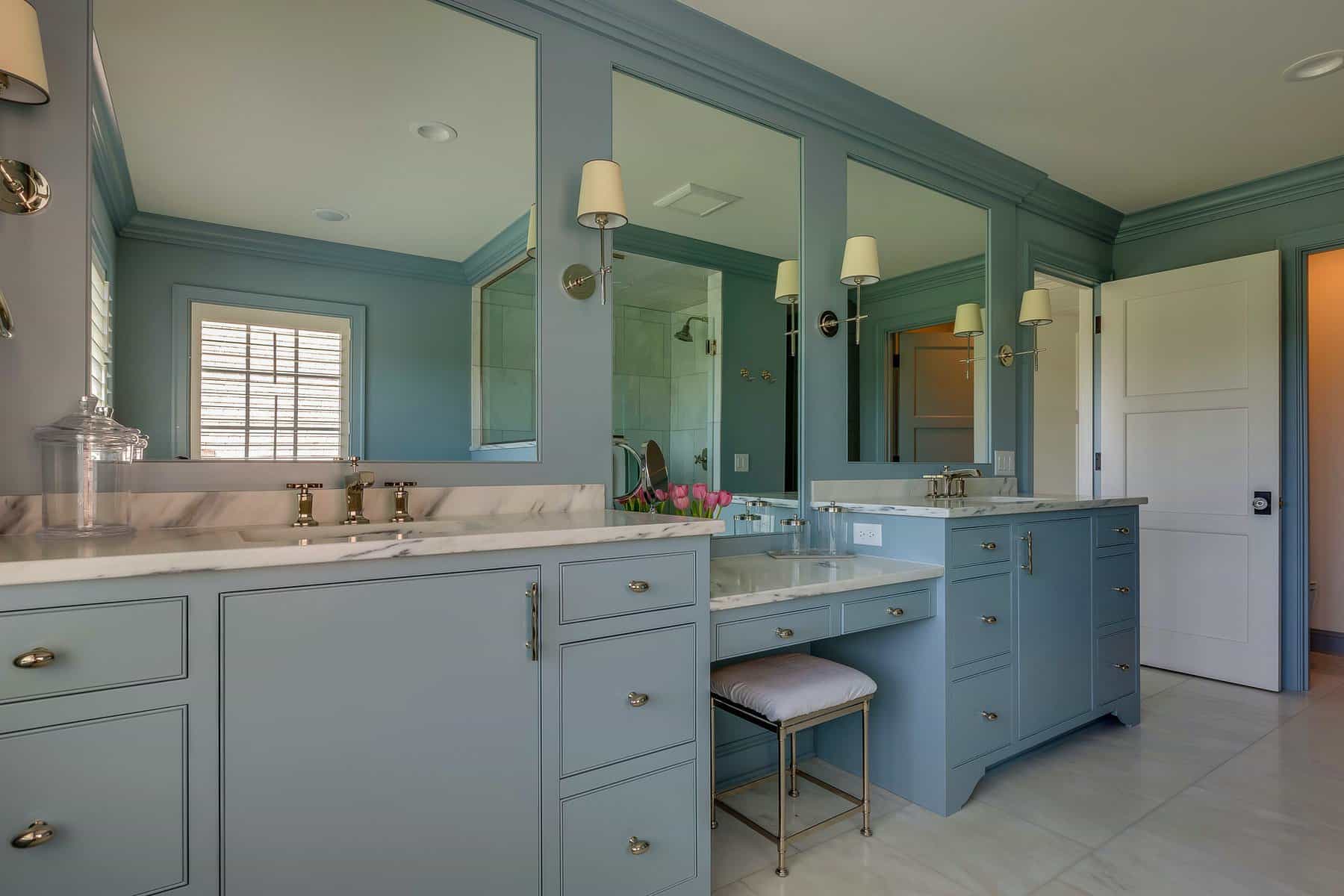
Why Bathroom Cabinets Need Different Paint Than Other Rooms
Bathroom cabinets face moisture conditions that no other cabinet in your home deals with. A hot shower can push humidity to 100%, and that level of moisture stresses paint in ways that most products are not built for.
Three things happen to bathroom cabinets that do not happen in kitchens:
- Daily humidity spikes from showers create cycles between dry and saturated air
- Splash zones around sinks expose cabinet bases to direct water contact
- Poor ventilation traps moisture against cabinet surfaces for hours after each shower
The U.S. EPA’s guide to mold and moisture recommends keeping indoor humidity between 30 and 50% to prevent mold growth. Most bathrooms blow past that range every time someone showers, which is why cabinet paint here has to do more work.
That stress is why the best paint for bathroom cabinets is not the same as wall paint or even budget cabinet paint.
Paint or Replace? Decide Before You Start
Painting your existing cabinets is almost always cheaper than replacing them. Replacement runs $5,000 to $15,000+ for a typical bathroom vanity. Painting runs $300 to $1,200 in materials and labor for the same project.
That said, painting only works if your cabinet boxes are structurally sound. Replace instead of paint if:
- The cabinet boxes are warped or water-damaged
- Particle board cores are swollen or crumbling
- Doors are sagging because hinges have stripped the wood
- You hate the cabinet layout, not just the color
A full cabinet replacement comparison breaks down where each option makes more sense, so you can run the math on your cabinets before you commit.
If your cabinets pass the structural check, painting saves real money and delivers a fresh look in under a week.
Best Paint for Bathroom Cabinets in 2026
The best paint for bathroom cabinets shares 3 things in common: hard cure for moisture resistance, mildewcide additives that fight mold, and cabinet-specific formulation.
Five products dominate the professional tier:
| Product | Type | Why It Works for Bathrooms |
|---|---|---|
| Benjamin Moore Advance | Waterborne alkyd | Factory-quality finish, hard cure over 30 days |
| Benjamin Moore Aura Bath & Spa | Acrylic with mildewcide | Only matte rated for bathroom moisture |
| Sherwin-Williams Emerald Urethane Trim Enamel | Urethane-modified alkyd | Fastest cure, hardest film |
| INSL-X Cabinet Coat | Acrylic enamel | Budget pro-tier, mildew resistant |
| Benjamin Moore Scuff-X | Acrylic with antimicrobial | Built-in mold protection, fast 2 to 4 hour recoat |
Skip standard wall paint, eggshell paint, and any product not labeled for cabinets or bathrooms. Wall paint stays soft and shows fingerprints within months.
For most bathroom cabinet projects in Pacific Northwest homes, Benjamin Moore Advance or Sherwin-Williams Emerald Urethane delivers the best balance of finish quality and moisture resistance.
How to Paint Bathroom Cabinets: The Step-by-Step Process
Here is the full process for how to paint bathroom cabinets, in the order you actually do it. Skipping steps or rushing the timing is what kills bathroom cabinet paint projects.
The 9-step process:
- Remove all hardware. Knobs, hinges, drawer pulls. Label each door for reinstall.
- Take doors and drawers off. Spray flat for the smoothest finish.
- Clean with TSP or degreaser. Removes soap scum and oils that block adhesion.
- Sand with 220-grit sandpaper. Breaks the factory gloss. Wipe dust with a tack cloth.
- Fill holes with wood filler. Sand smooth once dry.
- Apply a bonding primer. Benjamin Moore Stix or Zinsser B-I-N for tannin-heavy woods.
- Apply two thin top coats. Sand lightly between coats. Follow product recoat times.
- Cure undisturbed for 24 hours. Avoid hot showers during this window.
- Reinstall after 30 days for full cure. Use bumper pads on doors.
Spraying delivers the smoothest factory finish if you have access to a paint sprayer. Brushing and rolling work fine with a fine-finish roller and self-leveling cabinet paint.
Picking the Right Color and Sheen for Bathroom Cabinets
Sheen affects moisture resistance more than most homeowners realize. Higher sheens have smoother, less porous surfaces that resist water penetration.
For bathroom cabinets, your real options are:
- Satin: Soft sheen, hides minor flaws, decent moisture resistance
- Semi-gloss: Pro recommended default, balances cleanability and finish quality
- High-gloss: Maximum moisture resistance, shows surface flaws
Skip flat, eggshell, and matte for bathroom cabinets. They absorb moisture, hold dirt, and fail within 1 to 2 years.
Color choice matters too. White, soft gray, navy, and warm taupe are the four most popular bathroom cabinet colors in 2026. Lighter colors hide hard water stains better. Darker colors hide fingerprints better.
The full guide to paint color selection covers how to match cabinet color to your tile, countertop, and lighting before you commit to a final pick.
Should You Apply One Coat or Two?
Two thin coats almost always outperform one thick coat on bathroom cabinets. Thick coats sag, drip, and never fully cure into the hard film that handles moisture.
Here is why two coats matter for bathroom cabinets specifically:
- The first coat seals the substrate and bonds to the primer
- The second coat builds the moisture barrier and color depth
- Sanding lightly between coats gives you the smoothest factory finish
- Two thin coats cure harder and faster than one thick coat
Some premium cabinet paints (like Benjamin Moore Advance) can deliver acceptable coverage in one coat over a tinted primer. For most bathroom cabinets, two coats is still the right call.
The full breakdown of one vs two coats shows when each approach makes sense based on color change, substrate, and product type.
Pacific Northwest Considerations for Bathroom Cabinet Projects
Pacific Northwest bathrooms face higher year-round humidity than most U.S. regions. That changes how bathroom cabinet paint cures and how long it lasts.
Three PNW factors affect bathroom cabinet projects:
- Indoor humidity stays high year-round. Even outside bathroom use, PNW homes run 40 to 60% relative humidity.
- Cure times stretch longer. Add 25 to 50% to manufacturer recoat times during winter months.
- Mildew pressure is real. Per the CDC’s guidance on mold, persistent moisture creates ideal conditions for mold to grow on indoor surfaces.
Old PNW homes often have cedar or old-growth fir cabinets that bleed tannins through new paint. A shellac-based primer (Zinsser B-I-N) blocks the tannins before they yellow your finish.
For upscale bathroom remodels, Mercer Island house painters and crews across King County typically use waterborne alkyd or urethane enamel products because the moisture handling matches the climate. The product matters more here than in drier markets.
Common Mistakes That Kill a Bathroom Cabinet Paint Project
Most bathroom cabinet paint failures trace back to 5 common mistakes. None of them has anything to do with brush technique.
The 5 most common DIY failures:
- Skipping primer on glossy surfaces. Topcoat will not bond to the factory finish without a bonding primer.
- Using wall paint instead of cabinet paint. Wall paint stays soft, shows fingerprints, and fails fast.
- Reinstalling doors before cure is complete. Causes blocking and tackiness that requires a full redo.
- Painting in a humid bathroom. Cure conditions matter. The bathroom should be dry and ventilated, not freshly showered.
- Applying coats too thick. Thick coats sag and never fully cure into the hard film bathrooms need.
Get those 5 right and your bathroom cabinets will hold up through years of daily showers, splashes, and humidity cycles.
Choosing the Right Approach for Your Project
DIY bathroom cabinet painting works if you have the time, the right products, and patience for full cure cycles. For homeowners who want a factory-quality finish without the 2-week project window, pro cabinet painting services handle the prep, primer, application, and cure timing in 5 days.
Either way, the rules are the same. Use the right paint, prep correctly, and let it cure before you turn on the shower.
Call us at 253-893-8330 for a FREE estimate today.